Behind every story is
a life that cannot be
summed up in a headline
ANASTASIA EFREMOVA
ECONOMICS & PUBLIC POLICY JOURNALIST
Exploring the intersection of
economics and public policy
through journalism
BEYOND THE BYLINE
Projects & Activities
Explore four areas that have shaped how I investigate questions, lead people, and turn ideas into practical work.
JOURNALISM, EDITORIAL & MEDIA
7 Roles
Reporting, editing, research, fact-checking, and publishing
ECONOMICS & PUBLIC POLICY RESEARCH
1 Independent Research Project
Economic behavior, public policy, research ethics, and responsible research design
LEADERSHIP & MENTORING
6 Roles
Team-building, mentoring, communication, public speaking, and community leadership
ENTREPRENEURSHIP & FINANCIAL EDUCATION
5 Ventures & Financial-Education Initiatives
Programs, curriculum, investing, financial education, and venture-building
Kids Business Club & Teen Investor Club
Founder · Instructor · Youth Venture Mentor
Orange County, California + Online Across the U.S.
Learning to Earn Before Learning to Teach
My relationship with entrepreneurship began at six, long before I thought of it as a subject I could teach.
At my first youth business fair in Costa Mesa, a friend and I created candy bouquets and Thanksgiving candy centerpieces. Our small business won the event’s Grand Prix and a $250 prize, including recognition for creativity.

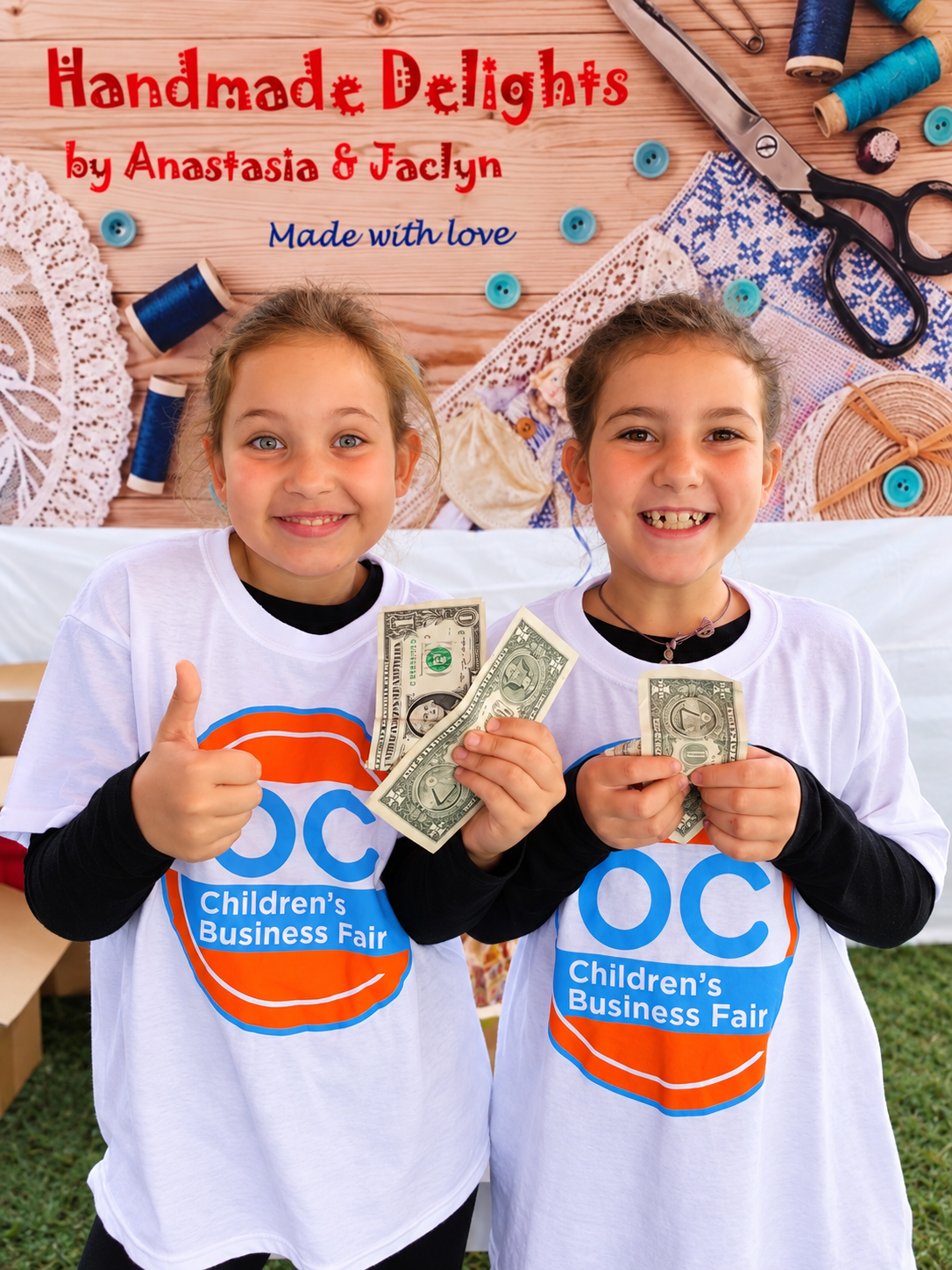
That experience made earning money feel creative rather than abstract. Over the years, I kept experimenting: dog sitting, babysitting, tutoring, teaching English online to children abroad, garage sales, handmade products, teacher gifts, smoothies and cookies, and dozens of business fairs.
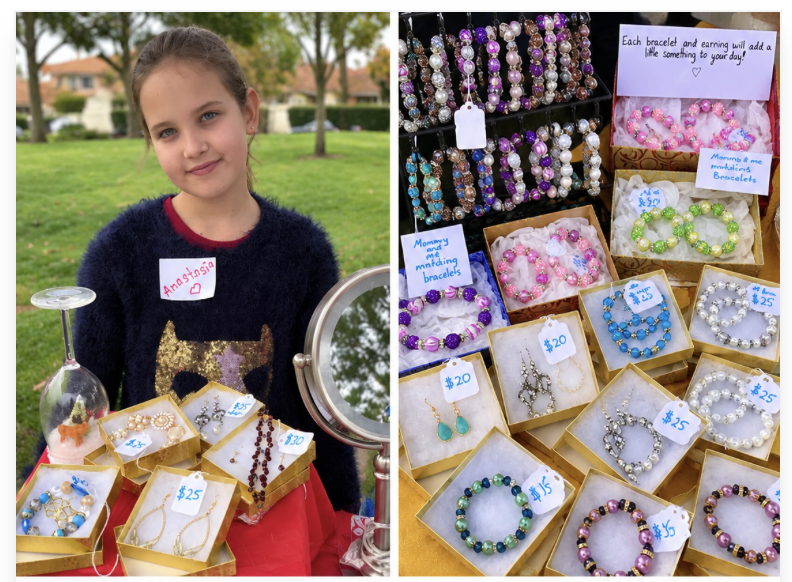
Some ideas worked much better than others. Dog sitting became one of my favorites because I could earn money doing something I genuinely enjoyed. Handmade bracelets became one of my most profitable products: materials and gift packaging cost roughly $2–$3 per bracelet, while I could sell them for $15–$20, eventually earning about $1,000 across several fairs.
Learning to Think About Profit
As I grew older, I stopped looking only at how much money came in and began thinking about what remained after expenses.
That changed the way I approached business fairs.
For one competition, I challenged myself to create products with essentially zero new material cost. For weeks, I collected leftover toys, craft materials, containers, and objects around the house that might otherwise have been discarded and transformed them into small handmade products and fidgets.
The project later earned first place at the fair.
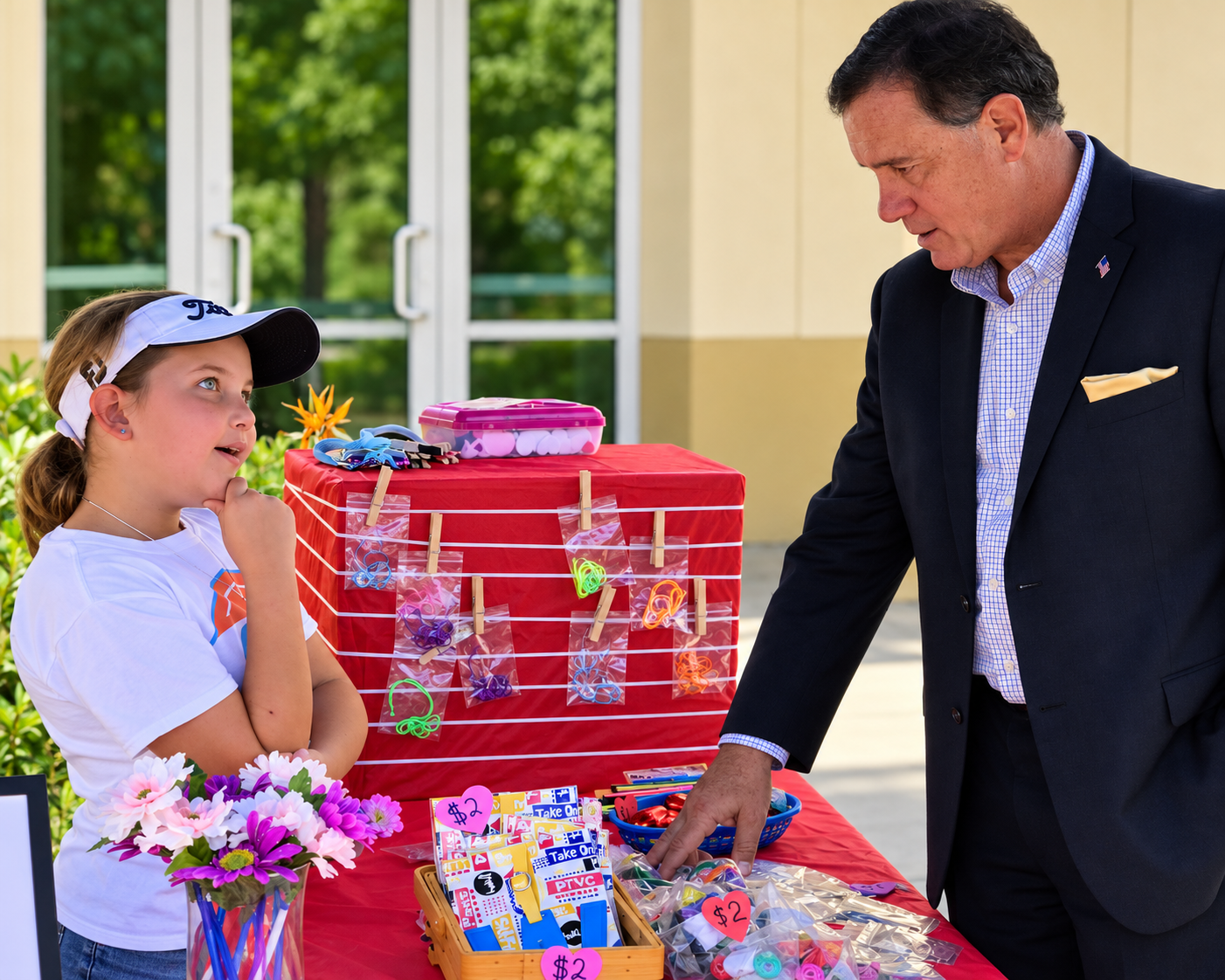
That experience taught me that entrepreneurship is not always about having more resources. Sometimes it begins by seeing more possibilities in the resources already around you.
Turning a “Want” Into an Earning Plan
I developed one rule for myself early:
A new goal meant a new plan to earn—not a reason to empty what I had already saved.
If I wanted something small, I tried to earn the money for it again rather than taking money from longer-term savings.
Over time, those goals became larger: an iPad, an iPhone, AirPods, a trip to Paris, a $1,500 business camp, and eventually money I could invest rather than spend.
The point was not simply to save. It was to know why I was saving and to understand the difference between money I wanted to spend and money I wanted to put to work.
From Selling to Solving a Customer Problem
One of my favorite lessons came from teacher gifts.
Instead of asking parents to search for a present themselves, I created ready-to-give holiday sets: mugs, chocolate, cocoa, marshmallows, seasonal decorations, and later handmade bracelets packaged in small gold gift boxes.
The product was not just the bracelet or the cocoa. The product was also convenience—a finished solution for a parent who needed a thoughtful teacher gift but did not have time to build one.
That was one of the first times I understood that a business becomes more valuable when it solves a specific problem for a specific customer.
From Young Entrepreneur to Program Builder
2019: The First Summer Business Camp
In summer 2019, after my mother closed her after-school program and the facility was temporarily still available, I proposed using the space for something new: a Kids Business Camp.
The first program took place in Lake Forest, California, with eight children ages roughly 10–12. It ran for five days, six hours a day, followed by another five-day session.
Although my mother supervised the program, I designed and led most of the activities myself.
Students created Dream Boards around a financial goal. In the center, each child placed something they wanted—a pair of headphones, a purchase, an experience—and researched its cost. Around that goal, they developed realistic ways they could earn the money themselves.
Then we turned those ideas into a plan.
From Dream to Plan
Students learned to ask:
What do I want?
→ What does it cost?
→ How can I earn it?
→ How often do I need to do that activity?
→ What will it cost me?
→ How much profit will remain?
→ How long will it take to reach my goal?
They learned the difference between earning wages, working independently, building a small business, and eventually creating systems that could scale.
We also practiced pricing, product versus service businesses, profit, customer needs, and simple investing concepts.
Practicing the Sale Before the Sale
One of the most useful exercises was a kind of miniature sales theater.
A student would become the entrepreneur and give a 15–20 second pitch explaining what they were selling, why someone should care, and what problem the product or service solved.
The other students became different types of customers:
- interested buyer,
- uncertain buyer,
- skeptical buyer,
- customer who immediately said no.
The entrepreneur had to listen, respond, handle objections, and adjust the pitch.
Then everyone switched roles.
We used the same principle for an investment-pitch activity: students presented business ideas while their peers acted as investors, decided whether they would invest play money, and explained why the idea did or did not earn their confidence.
I was not trying to teach children polished business vocabulary. I wanted them to experience what it feels like to offer an idea, hear “no,” revise it, and try again.
2020: Taking the Program Online
When COVID shut down normal activities, I initially created an online social group so children could stay connected through challenges, videos, recipes, and projects.
Then I returned to the idea I had enjoyed most from the previous summer: teaching business and money.
We advertised online, and interest quickly expanded beyond California. I began running multiple Zoom cohorts with children from states including California, Texas, New York, Florida, and Washington.
Groups stayed intentionally small—generally no more than six students. Each cohort met approximately twice a week for 90 minutes, and some students remained for three, six, or even nine months.
Parents paid $15 per 90-minute session, and many voluntarily sent additional tips.
This was no longer only a youth activity. It had become a real paid educational program.
External Recognition: From Second Place to First
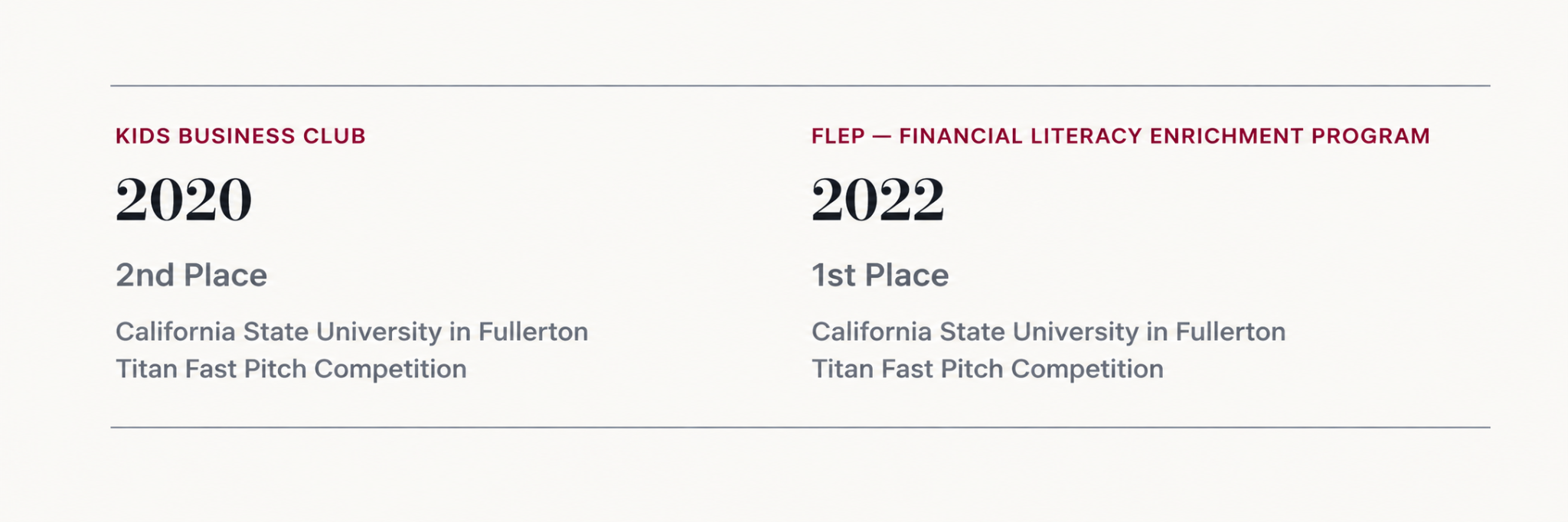
In 2020, I presented Kids Business Club at the Titan Fast Pitch Competition, organized by California State University, Fullerton, and won second place.
In 2021, the university asked me to record a bootcamp video for future Titan Fast Pitch Competition participants on how to prepare, structure, and deliver a competition pitch. The recording became an educational resource distributed to middle and high school participants in subsequent years.
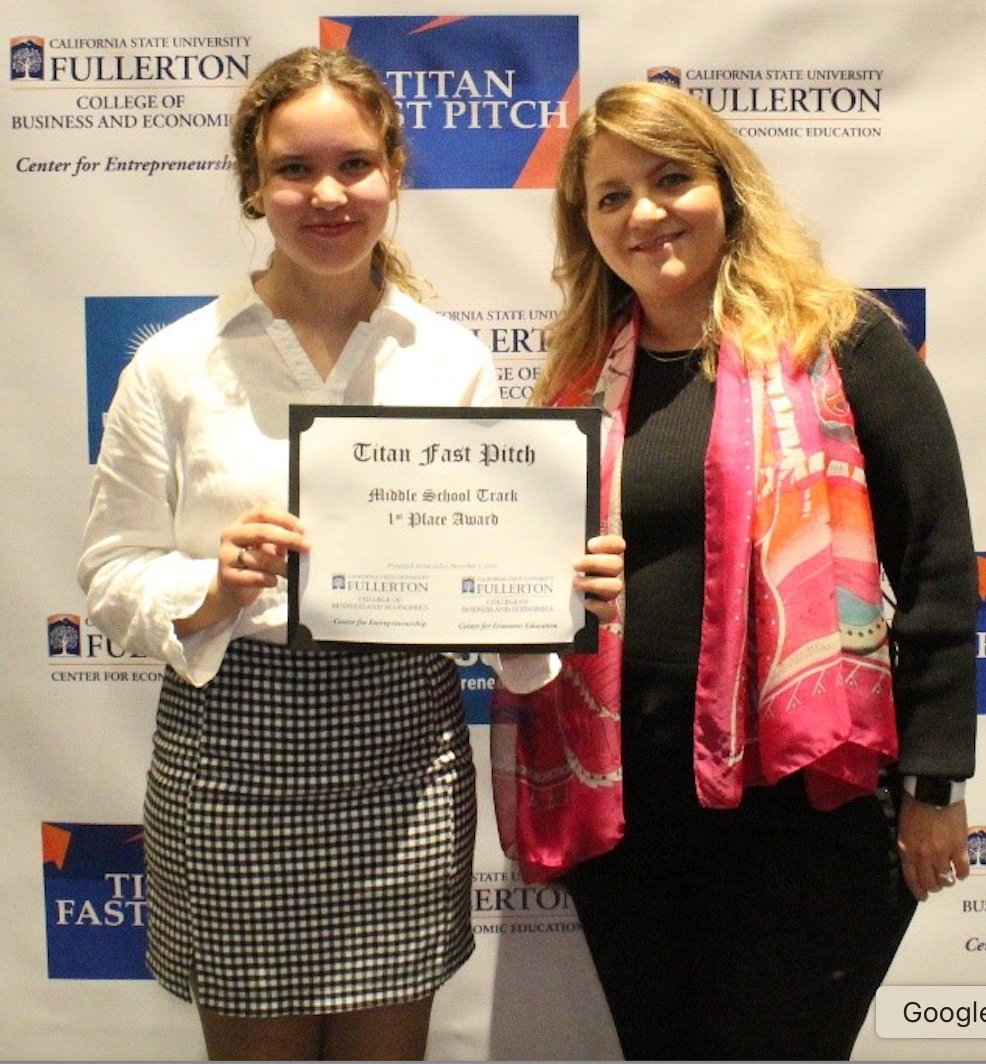
In 2022, I expanded my original program into FLEP — Financial Literacy Enrichment Program, introducing a more structured approach to teaching children about earning, saving, managing, and investing money. I returned to the Titan Fast Pitch Competition with this improved program and won first place.
What began as a student business idea had grown into an educational program that could help other young entrepreneurs prepare for their own competitions.
Making Adult Financial Concepts Understandable to Children
One of the central tools was the adult Cashflow game.
I realized very quickly that the full game was too complicated for most children, so I adapted the way we used it.
Instead of introducing every rule at once, I broke the learning process into several levels. Students began with a simplified version and gradually added more difficult concepts as their understanding grew—borrowing, investments, stocks, real estate, and later more advanced financial ideas.
The goal was not to make the game easier forever.
The goal was to create enough structure for a child to eventually understand something that initially looked too complicated.
Growing Into the Teen Investor Club
As I grew older, the original Kids Business Club began to feel too basic for the questions I wanted to explore myself.
I became increasingly interested in stocks, real estate, passive income, financing, risk, rental analysis, compound growth, and how investors identify opportunities other people overlook.
That led to the Teen Investor Club.
By then, I was no longer teaching only how to earn the first $100. I was asking students to think about what happens after money is earned:
How can money make more money?
We explored investments through games, examples, discussions, and real-world scenarios.
By then, I was also teaching concepts I had already begun applying to my own money.
My personal investment journey continues in the Investing & Property Management section →
Teaching Students to See What Others Miss
One of my favorite exercises began with something that looked almost worthless: an empty piece of land.
I would ask:
How many ways can you think of to make this land produce income?
Students proposed solar panels, cell towers, farming leases, RV or boat storage, BMX trails, obstacle courses, outdoor events—even an Easter egg hunt.
The point was not whether every idea would work.
The point was to train students to stop seeing an asset in only its most obvious form.
We used the same approach with rental housing. Instead of assuming every property should simply be rented to a typical long-term tenant, students learned to ask:
Who is the customer?
A traveling nurse near a hospital has different needs from a military family near a base, a student near a university, or an employee temporarily relocated by a corporation.
That idea—define the customer before designing the business model—became one of the principles I returned to again and again.
KIDS BUSINESS & TEEN INVESTOR CLUBS IN FACTS
50+
Students Taught
23
Teen Investors
34
Business Fairs & Selling Events Participated In
8
Students in the First 2019 Camp
2× / Week
Typical Online Cohort Meetings
90 Min.
Per Online Session
What Students Took With Them
Students did not all have the same goal.
Some wanted to earn $100. Others aimed for $150, $200, $240, or $300.
What mattered was that a goal became something they could reverse-engineer.
Many returned to later camps, clubs, and business fairs even after their formal program ended. Some continued creating new goals and earning independently at home.
The strongest sign that the program worked was not that a child completed one assignment.
It was that the child began asking:
What else could I try?
What I Wanted Them to See
The purpose of the clubs was never to convince every child to become an entrepreneur or investor.
It was to widen the set of possibilities they could imagine.
If the only financial model a child sees at home is employment, it is easy to grow up assuming employment is the only normal path.
I wanted students to know that people can work for money, work independently, build businesses, delegate, invest, and eventually create situations in which money itself produces income.
Most importantly, I wanted them to experiment with those ideas while the stakes were still small.
A child can try selling bracelets, pitching an idea, calculating profit, hearing “no,” losing ten dollars, changing the plan, and trying again.
Those experiences are much less frightening at ten than they can be at thirty.
For me, financial education was never only about teaching children how money works. It was about giving them enough experience with different possibilities that, when they grew up, those possibilities would no longer feel unfamiliar or impossible.
Stock Market Investing
Investor · Independent Researcher · Fact-Checker
Orange County, California · Started with $2,000 of Personally Earned Savings
From Earning Money to Putting It to Work
By age ten, I had already spent years experimenting with ways to earn money.
Some of it came from business fairs and public-speaking competitions where winning meant receiving a cash prize. The rest came from ideas I kept testing myself: dog sitting, babysitting, tutoring, teaching English online to children abroad, garage sales, handmade products, teacher gifts, smoothies, cookies, and dozens of business fairs.
No single activity created a large amount of money. But together, they taught me something important: small amounts become meaningful when you keep earning, saving, and resisting the temptation to spend everything you make.
Eventually, I had saved $2,000.
That raised a new question.
I knew how to earn money. But could I learn how to make the money I had already earned begin working for me?
My First Investment
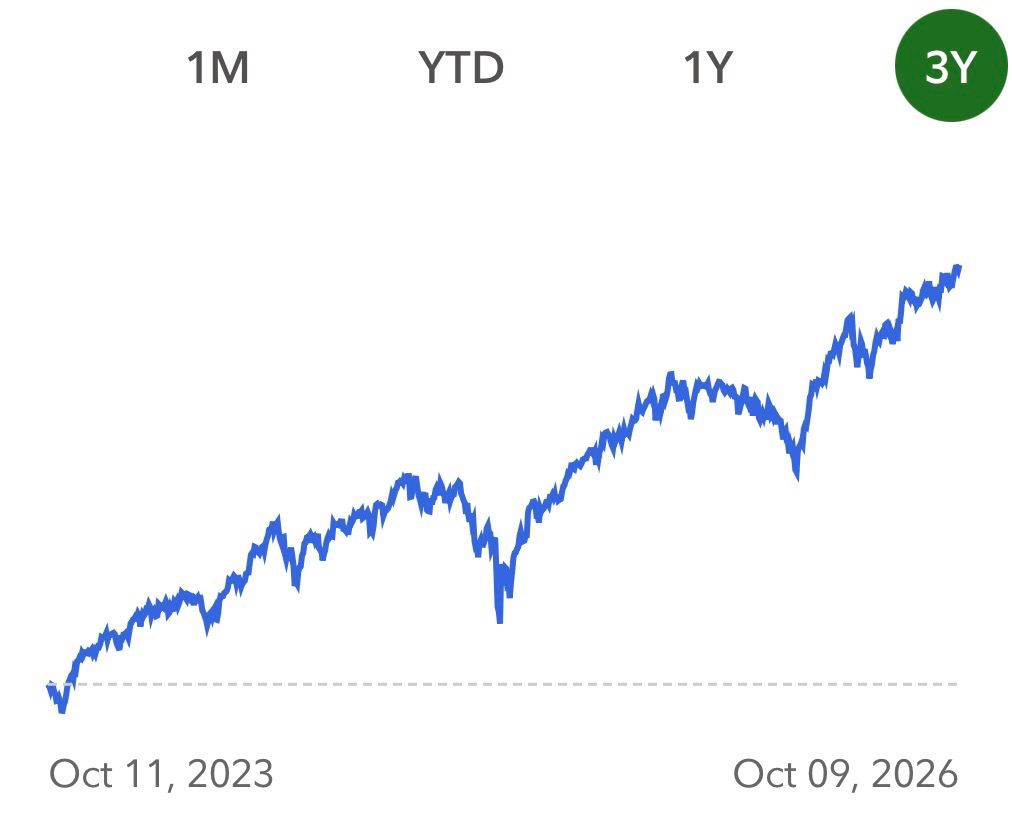
At age ten, I put my first $2,000 into the stock market.
At first, investing seemed simple from the outside: choose a company, buy shares, and hope the price goes up.
It did not stay simple for long.
Once my own money was involved, I wanted to understand what I was actually buying. I began reading about companies, comparing financial information, following business news, looking at competitors, and trying to understand why one company might grow while another might struggle.
I learned quickly that a recognizable company was not automatically a good investment and that a rising stock price did not necessarily explain what was happening inside the business.
Some decisions worked better than others.
That was useful too.
A mistake involving real money made me much more interested in understanding why I had been wrong than in finding an excuse for the result.
Research Before Investment
Over time, the research became almost as interesting to me as the investing itself.
Before making a decision, I wanted to know:
What does the company actually do?
How does it make money?
Who are its competitors?
What has changed recently?
Which claims come directly from the company, and which can be independently verified?
Are the numbers being presented in context?
What information might be missing?
I became increasingly careful about separating a compelling story from evidence that actually supported it.
That habit later became important far beyond my own portfolio.
When Research Became Paid Work
Eventually, other people began asking me to help them with research.
Sometimes they were considering a company, industry, or investment and simply did not have the time to search through all of the publicly available information themselves.
I began taking paid research and fact-checking assignments.
My job was not to tell someone what stock to buy.
Instead, I searched public sources, gathered relevant information, compared claims across sources, checked facts, organized what I found, and gave the client a clearer body of information to evaluate.
The client made the investment decision.
I was paid for the time, research, organization, and fact-checking that came before it.
That distinction became very important to me.
Information Has Value Too
Those assignments taught me something I had not understood when I made my first investment.
You do not always create value by producing a physical product.
Sometimes value comes from saving another person hours of work.
Sometimes it comes from finding information they did not know existed.
Sometimes it comes from noticing that two sources contradict each other and checking which one is correct.
And sometimes the most responsible result of research is not a confident answer.
It is saying, “There is not enough reliable information yet.”
Learning to Separate Evidence From Decisions
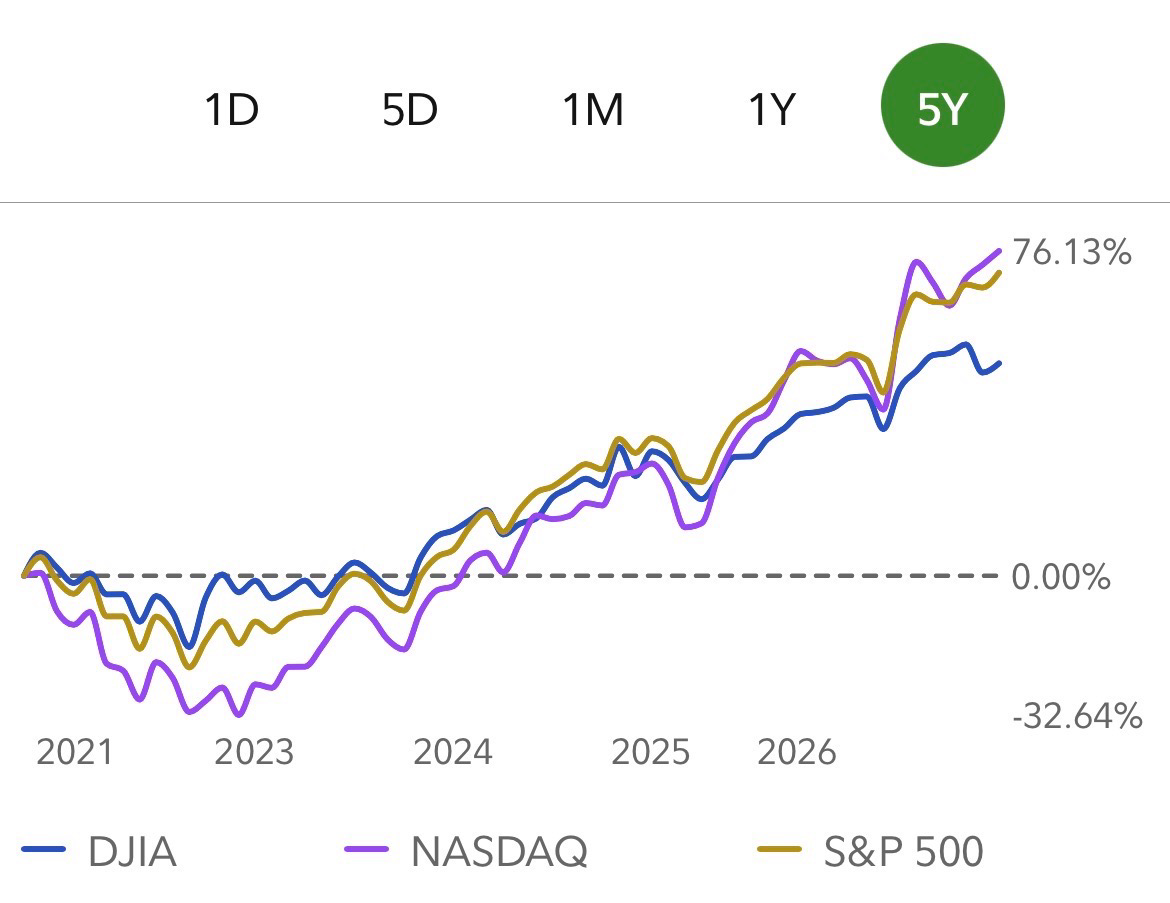
Stock-market investing also taught me to separate two things that are easy to confuse: research and judgment.
Good research can improve a decision, but it cannot eliminate uncertainty.
I could study a company carefully and still be wrong about what happened next. Markets could move for reasons I had not anticipated. New information could appear. A company could execute differently than expected.
That uncertainty made research more important, not less.
I became more comfortable asking questions, checking assumptions, and changing my view when new evidence contradicted the conclusion I had expected to reach.
What Investing Changed for Me
At ten, I thought investing was primarily about making money grow.
It became something much broader.
It taught me how businesses create value, how markets process information, how risk changes decision-making, and why the quality of the evidence behind a decision matters.
Earning my first $2,000 taught me that I could create income through my own effort.
Investing it taught me that money could become an asset.
Researching investments taught me something even more useful:
before I decide what I believe, I should understand what the evidence actually says.
Mississippi Rental Investment
Investor · Property Manager · Furnished-Housing Strategist
Gulfport, Mississippi · $6,000 Initial Investment · January 2022
From Stocks to a Real Property
After making my first stock-market investment at ten, I set a larger goal: save enough money to invest in real estate.
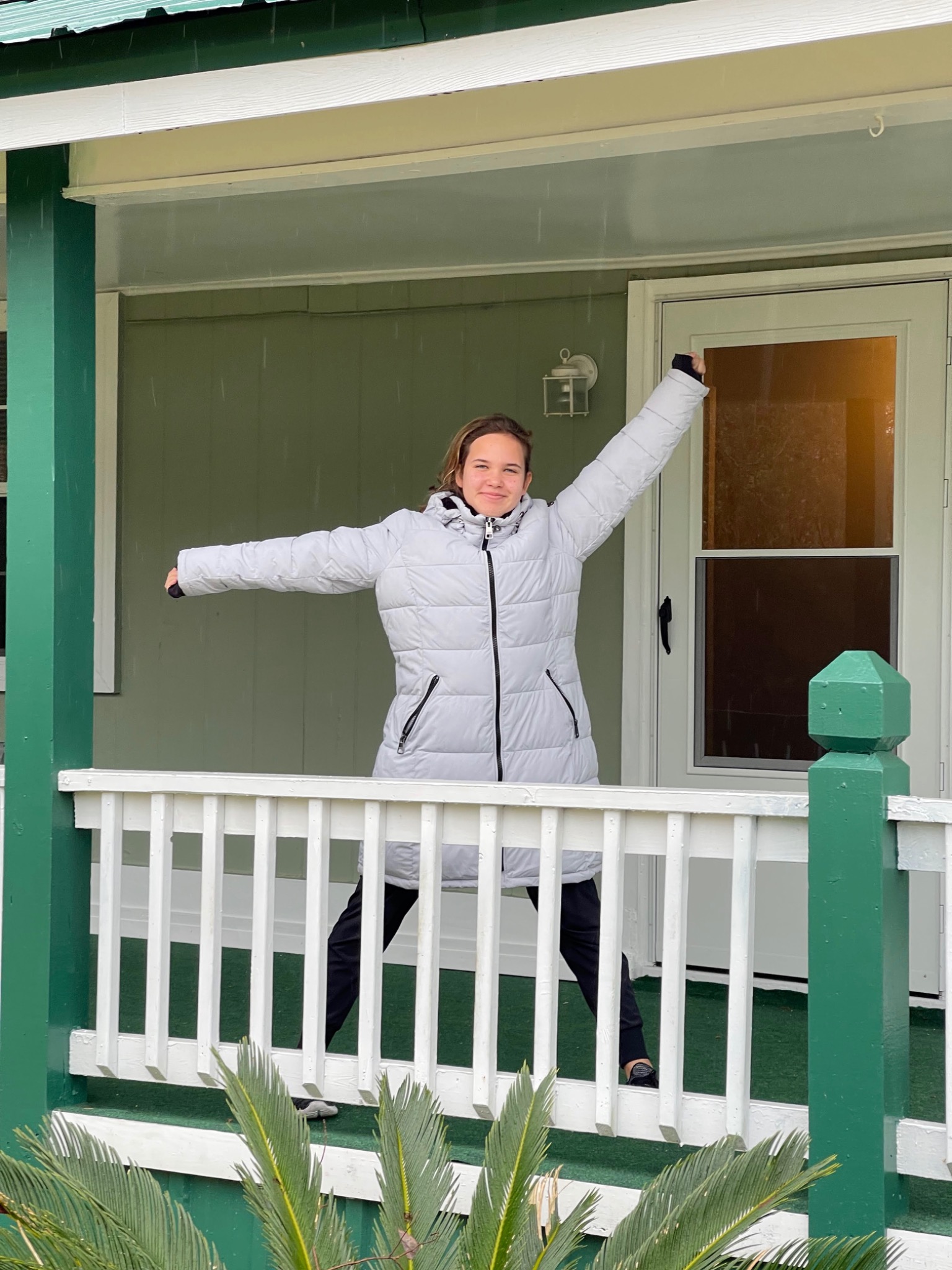
I kept earning and saving until I had $6,000. In January 2022, at twelve, I invested those savings in a family rental property in Mississippi. Because I was a minor, my parents handled the legal purchase and ownership, but the $6,000 I contributed came from years of my own work, competition prizes, and savings.
My investment represented a one-third economic share in the property, associated with a separately rented guest house.
Later, I reinvested another $4,000 of rental income into repairs, turning the property into something more than an investment I had helped fund. It became a business I could watch, analyze, and help operate.
Finding the Right Customer
One of the most important lessons came from deciding how to rent the guest house.
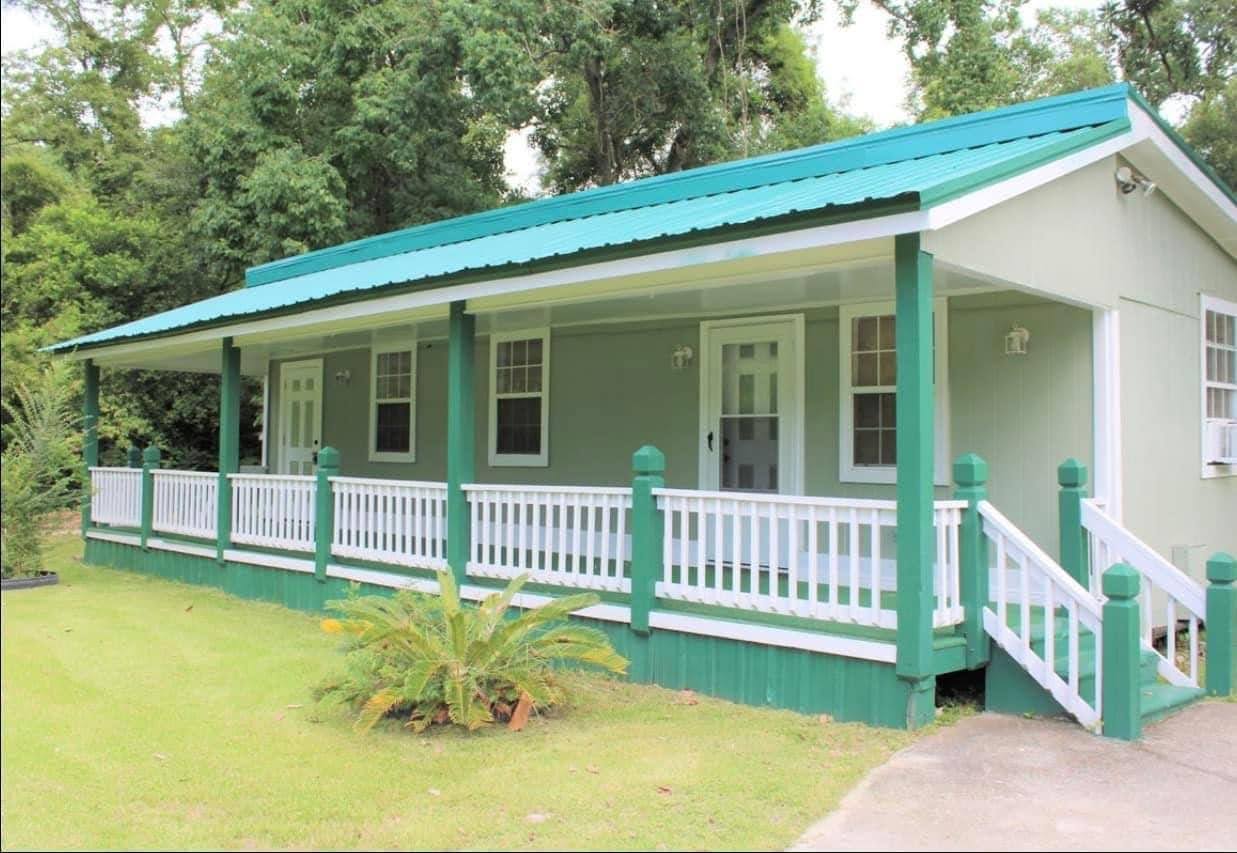
Instead of treating it as a standard unfurnished rental, we furnished it and designed the housing around people who needed a ready-to-live-in home: travel nurses, military tenants and families, and professionals on temporary assignments.
The question was not simply, How much can this house rent for?
It was:
Who is the customer, and what problem does this property solve for them?
A travel nurse arriving for an assignment does not necessarily want to buy furniture, establish utilities, and sign a traditional lease. A military family relocating temporarily may have the same problem. Providing furniture, appliances, internet, utilities, and flexible housing turned the same physical property into a different product for a different market.
Today, the furnished guest house rents for $1,250 per month.
Learning What Cash Flow Really Means
Collecting $1,250 in rent did not mean earning $1,250 in profit.
I learned to account for the mortgage, property taxes, insurance, utilities, maintenance, repairs, and the money that needed to stay in the property.
REAL ESTATE FORMULAS IN PRACTICE
Monthly
Cash Flow
=
$1,250 − ($198 mortgage + $50 property tax + $70 insurance + $200 utilities & maintenance) ≈ $732 / month
Using the current numbers, the guest house produces approximately $732 in monthly cash flow, or about $8,781 per year after those recurring expenses.
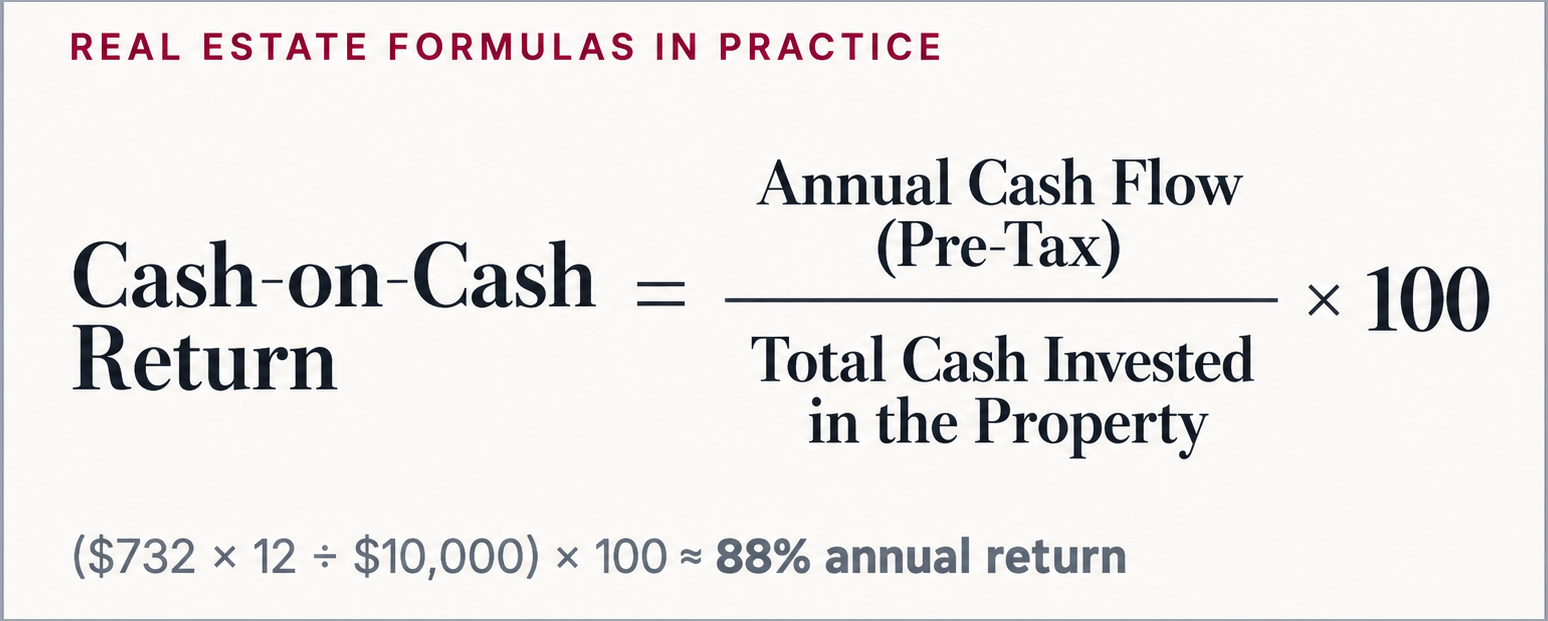
Against approximately $10,000 of total capital invested and reinvested, that is roughly an 88% annual cash-on-cash return.
The formulas made the result visible, but what fascinated me was understanding why the numbers changed. Better positioning, stronger tenant fit, careful expense control, and better management all showed up in the cash flow.
The same guest house could produce very different results depending on who it served, how it was furnished, what expenses were included, how tenants were found, and how carefully the property was managed.
From Investor to Property Manager
Over time, I became involved in the work behind the income: tenant communication, listings and advertisements, lease review, bookkeeping, cash-flow tracking, and property-management decisions.
By fourteen, I had learned how to help manage rental homes more independently. I communicated with tenants, learned where different types of renters searched for housing, wrote and placed listings, and compared which platforms produced strong inquiries and which ones did not. I began to understand that finding a tenant was not simply a matter of posting an address online; the wording, photos, target customer, platform, timing, and follow-up could all change the result.
Gradually, my role expanded beyond the Mississippi property. I began helping my parents with more of their rental portfolio and became increasingly involved in the family property-management business—tracking listings, communicating with tenants, reviewing leases, helping solve day-to-day issues, and doing bookkeeping.
The numbers fascinated me. I liked being able to connect a decision I had made to a result I could measure: a better response to an advertisement, lower vacancy, a repaired unit returning to service, improved monthly cash flow, or a stronger cash-on-cash return. Seeing that progress made me want to understand the business more deeply and improve the next decision.
Real estate taught me that passive income is not the same thing as effortless income.
The property can earn money while I am in school, but someone still has to understand the numbers, solve problems, communicate with tenants, maintain the asset, and decide what to do when circumstances change.
That experience later became one of the real-world foundations for my Teen Investor Club and Teens Investment Toolkit: I was no longer explaining cash flow, customer segmentation, or rental strategy only from a textbook. I had watched those decisions affect an actual investment.
Earn → invest → operate → analyze → teach.
From Experience to Education
What began with earning money, making my first real estate investment, and teaching others eventually grew into the Teens Real Estate Investment Toolkit. I transformed my firsthand experience and the questions my students asked into practical learning materials designed to help teenagers understand real estate investing, make informed decisions, and eventually launch investment clubs of their own.
LEARN MORE ABOUT THE TOOLKIT →